Maps, diagrams, and Chairwork: making the dynamics between modes concrete for your patients.
Mini Chairs: Many possibilities
Designed and developed for online and in-person sessions, the Mini Chairs aim to make patients’ internal functioning easier to visualize and understand in a playful, concrete, and creative way.
This tool allows us to represent the various parts that make up a person’s mind and the dynamics between them, supporting psychoeducation and the construction and sharing of case conceptualization between psychologist and patient.
The Mini Chairs can be used in many ways, drawing on different approaches within Psychology.
Do not limit yourself to what I will present in this mini application.
We believe this is a resource full of possibilities. Feel free to explore, and if you wish, share your ideas with us!
1
Psychoeducation
The Mini Chairs can be used to symbolize parts or sides that make up a person’s mind, making it easier for them to recognize, understand, and take ownership of their internal functioning.
You can suggest representing, with one of the Mini Chairs, the part/side/mode being addressed in the session, placing it on a surface at the height of the camera through which the patient sees you (in online sessions). See more about the Whiteboard in the ‘Resources’ tab.
You can use one Mini Chair at a time to work with a particular mode/part. You can also use several Mini Chairs at once to represent different modes and the dynamics between them, visually showing what these sides are and how they relate to one another.
The Mini Chairs support the way you explain the interaction between the patient’s emotions, thoughts, and behaviors; in other words, they illustrate the conceptualization of the dynamics taking place within them.
2
Chairwork online and in person
The Mini Chairs bring Chairwork into the online environment without losing depth.
If you already know and apply Chairwork in therapy, you can now bring this experience into the online environment with the support of the Mini Chairs. They make it possible to visually represent the patient’s different parts, modes, or inner voices, encouraging externalization and dialogue between them, even at a distance.
In online sessions, the Mini Chairs work as a concrete visual resource that helps the patient locate themselves within the internal positions being explored: “who is speaking now?”, “who is listening?”, “where is the wounded part?”.
With them, the therapist can guide the process in a more engaging and intuitive way while preserving the depth of the experience, asking the patient to stand up and sit in different chairs available in their environment, or in different positions on the same chair as Chairwork recommends, while relating each place to a Mini Chair positioned on a surface visible to the patient on the screen.
It is a simple and creative way to adapt Chairwork to the digital context while preserving its transformative essence.
3
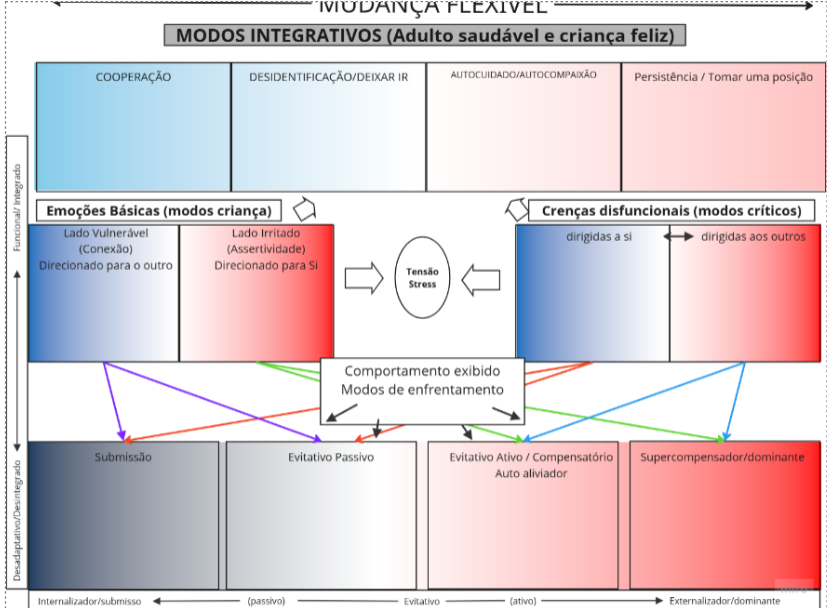
Contextual Schema Therapy Mode Map
Roediger et al. (2025) developed a map that describes patterns of interaction between modes.
Contextual Schema Therapy presents a mode map that describes patterns of interaction between modes that systematically repeat and that inspired us to define the colors of the Mini Chairs. The authors explain that the connection/interpersonal relationships pole can be represented in blue and the assertiveness pole in red. This map seeks to project the dynamics between coping modes, the modes that carry basic emotions (represented as child modes), and the mode that carries dysfunctional thoughts/beliefs (the internal critic mode).
The dynamic and dimensional perspective of Contextual Schema Therapy observes how the backstage movements of behaviors influence experience and perception, considering the variables of the modes simultaneously and in relation to one another rather than viewing them as static categories.
Coping Modes appear on the “front stage” as conscious behavior. Child Modes and Internal Critics are backstage, hidden yet shaping behavior.
Positioning the Mini Chairs on the map, or in the shape of the map, helps make the modes and the dynamics between them visible in a concrete way.
Shifting the focus that often becomes fixed on a coping mode toward the broader perspective of the Healthy Adult mode—and, from this perspective, seeking to understand one’s own functioning and interaction with others while simultaneously considering one’s basic emotional needs and values—can bring more effective responses to patients’ lives. This can also help them weaken the coping modes and critical voices that keep them trapped in vicious cycles.
Thus, positioning the Mini Chairs on the map, or in the shape of the map, helps make the modes and the dynamics between them visible in a concrete way.
The map below was translated on October 2, 2025 from the source below (Dr. Eckhard Roediger’s website):
https://www.schematherapy-roediger.org/images/Roediger/Slides/The%20coloured%20Mode%20Map%20with%20symptoms.pdf
4
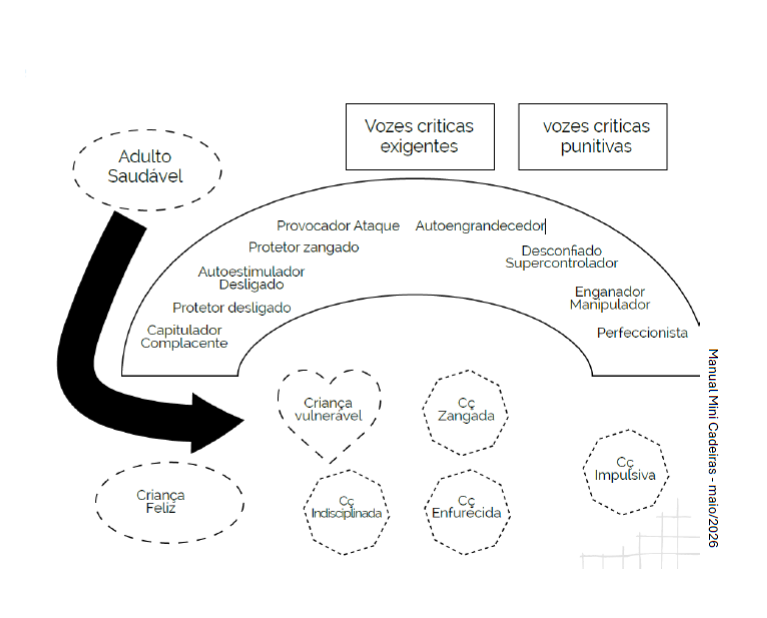
Simeone-DiFrancesco, Roediger, and Stevens Diagram (2015)
One of the diagrams most often recommended in the literature — it strengthens the Healthy Adult and stimulates the Happy Child.
This diagram is one of the most frequently recommended in the Schema Therapy literature. Its purpose is to strengthen the Healthy Adult mode and stimulate the Happy Child mode based on what the Vulnerable Child mode shows it needs. According to Atkinson and Perris (2020), these three modes form the healthy mode triad, and they emphasize the need to develop flexible patterns of interaction within this triad.
The goal is to protect the patient from internalized critical voices, bypass coping modes, and access the Vulnerable Child. The Angry Child needs validation; the Vulnerable Child needs to have its needs met. The Healthy Adult needs to be strengthened.
You can also position the Mini Chairs on the map, or in the shape of the map, to help make the modes and the dynamics between them visible in a concrete way.